
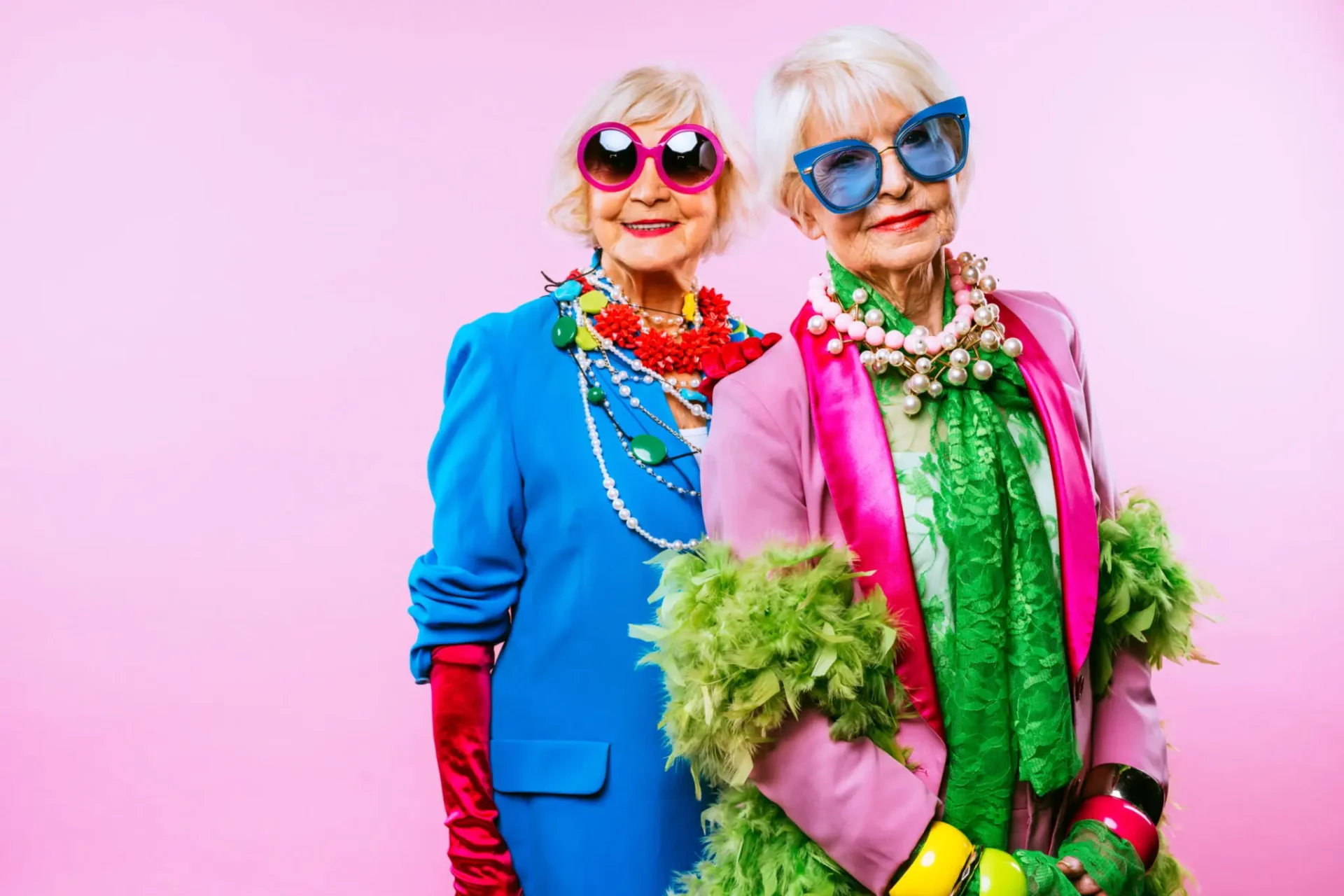
What We Say to Women Afraid of Looking Older
Separating Age from Worth
There’s a quiet fear that many women carry, often unspoken but deeply felt—the fear of looking older and what that might imply. It’s rarely just about appearance. It’s about what appearance has been taught to represent. Over time, age has been subtly, and sometimes overtly, tied to value. Youth has been positioned as currency, while anything outside of it has been treated as something to manage, soften, or conceal.
This is not accidental. It is the result of decades of messaging that linked a woman’s relevance to how closely she could maintain a certain look. The closer that look aligned with youth, the more visible, desirable, and “current” she was perceived to be. And the further she moved from it, the more she was expected to compensate—through effort, maintenance, or quiet adjustment.
So when a woman says she is afraid of looking older, she is not simply reacting to a number or a reflection. She is responding to a system of meaning that has been reinforced over time. That fear deserves to be understood, not dismissed. But it also deserves to be questioned.
Because age and worth are not inherently connected. They have been associated, but they are not the same. One is a measure of time. The other is something far more complex, shaped by presence, experience, perspective, and self-definition. When those two ideas are separated, even slightly, it creates room to rethink what has long been assumed.
This doesn’t happen instantly. It requires awareness and, often, a willingness to challenge beliefs that have felt stable for years. But once that separation begins, something shifts. The urgency to “maintain” starts to lose its hold. The pressure to preserve a version of the past becomes less convincing. And in its place, a different question begins to emerge—not how to appear younger, but how to feel more aligned.
At Go SILVR Goddess, this is where the conversation begins. Not by dismissing fear, but by reframing what that fear is actually about. Because when age is no longer used as a measure of worth, the entire experience of change becomes less about loss and more about possibility.
Redefining Attractiveness
Attractiveness has long been treated as a fixed standard, something to achieve and then maintain. But in reality, it has always been fluid, shaped by culture, context, and perception. The problem is not that standards exist—it’s that they have been presented as singular, leaving little room for individuality or evolution.
For many women, the idea of becoming less attractive is tied directly to the idea of looking older. It is not necessarily based on personal belief, but on what has been reflected back over time. Subtle cues, media portrayals, and social expectations all contribute to a narrow definition of what is considered desirable. Over time, those definitions become internalized, even when they no longer feel fully accurate.
Redefining attractiveness begins with expanding that definition. It involves recognizing that presence, confidence, and authenticity carry a different kind of appeal—one that is not dependent on fitting a specific visual standard. These qualities are not replacements for appearance; they are extensions of it. They change how appearance is perceived, not by altering it, but by grounding it in something more substantial.
This shift does not require abandoning aesthetics or personal style. It simply changes the source of influence. Instead of looking outward for validation, the reference point becomes internal. What feels aligned, what feels expressive, what feels real—these become the guiding factors.
When women begin to approach attractiveness in this way, it becomes less about maintaining a particular image and more about embodying a consistent sense of self. That consistency creates a presence that is difficult to define but easy to recognize. It does not rely on comparison, and it does not fade with time. It evolves.
At Go SILVR Goddess, attractiveness is not treated as something to preserve or protect. It is treated as something to redefine continuously. Not in response to external standards, but in alignment with personal identity. Because when attractiveness is no longer tied to a fixed ideal, it becomes far more expansive—and far more personal.
Offering Emotional Safety
Fear does not disappear simply because it is challenged. Even when beliefs begin to shift, there is often a period where uncertainty remains. This is especially true when it comes to appearance, because it is both personal and visible. It exists at the intersection of how a woman sees herself and how she expects to be seen by others.
In this space, emotional safety becomes essential. Not as reassurance that everything will be easy, but as an environment where complexity is allowed. Where questions can exist without immediate answers. Where decisions can be explored without pressure to commit or explain.
Emotional safety is not about eliminating discomfort. It is about creating conditions where discomfort can be processed without judgment. It allows women to move through change at their own pace, rather than feeling pushed toward a specific outcome. It removes the need to present certainty before it actually exists.
This kind of space is rare, but it is necessary. Without it, many women remain in cycles of hesitation—wanting to explore something different, but pulling back when uncertainty arises. With it, the process becomes more sustainable. It allows for experimentation, reflection, and gradual clarity.
At Go SILVR Goddess, emotional safety is not an afterthought. It is built into the way conversations are approached. There is no expectation to arrive with confidence fully formed. There is no pressure to adopt a particular perspective. Instead, there is an understanding that change is layered, and that each woman’s experience will look different.
Within that environment, something important begins to happen. The fear of being judged—by others or by oneself—starts to lose its intensity. Decisions feel less like risks and more like explorations. And over time, that shift creates space for something stronger than reassurance. It creates self-trust.
Self-trust is not loud, but it is steady. It allows a woman to make choices without needing constant validation. It supports her in moments of doubt, not by eliminating uncertainty, but by making it manageable. And once that foundation is in place, the fear of looking older begins to change. It becomes less about loss and more about interpretation.
Call to Action
If you’ve been holding onto the fear of looking older, you’re not alone—and you’re not expected to have it all figured out.
Go SILVR Goddess is where these conversations happen without pressure, without judgment, and without the need to fit into a predefined idea of what you should look like. It’s a space to question, to explore, and to redefine how you see yourself—on your own terms.